Girish Wankhede | btown.mumbai@gmail.com
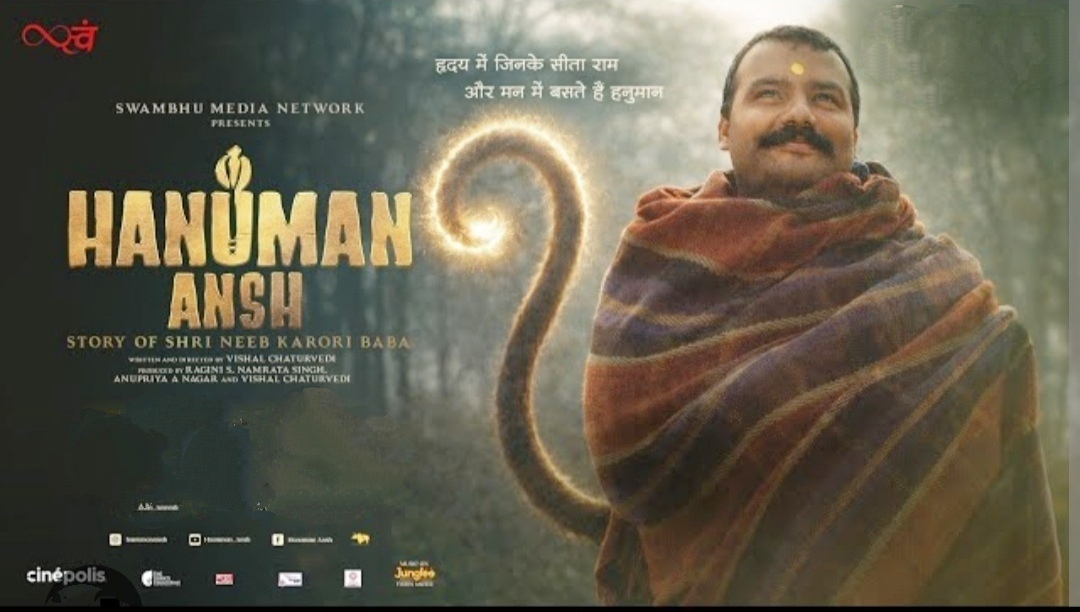
Hanuman Ansh did not arrive like a blockbuster. It arrived like a whisper. Released on 7 August 2026, Vishal Chaturvedi’s film on Neem Karoli Baba opened at about ₹10 lakh, with a few hundred shows and almost no campaign. After two weeks it had barely ₹1.48 crore. The trade had filed it under the usual small-devotional file: sincere, limited, finished. Then week three collected over ₹10 crore. By Day 22 it made ₹6.25 crore; on Day 23, a Raksha Bandhan Saturday, ₹9.25 crore. Shows jumped from a few hundred to more than 4,000. In 23 days the India net stood at ₹27.38 crore, the gross near ₹32 crore. Budget estimates range from ₹2 crore to ₹10 crore. Either way, the return is not a marketing story. It is an old Indian one: faith films do not always explode on Friday. They wait, then they occupy the hall.
That curve is not new. It is the original curve of Indian cinema. When Dadasaheb Phalke saw a film on the life of Christ, he asked why Indians should not see their own gods on screen. Raja Harishchandra (1913) answered him. The first Indian feature was a mythological. Lanka Dahan (1917) made audiences bow before Hanuman burning Lanka. Shri Krishna Janma and Kaliya Mardan followed. Before 1920, almost every Indian-made feature was mythological or saintly. The cinema hall was already a kind of shrine. Scholars later split the family into two cousins: the mythological, where gods appear in form, and the devotional, where a human saint or householder lives by faith — Sant Tukaram, Bhakta Prahlada, Sant Namdev, Sant Eknath. Darshan came before dialogue.
South India kept the flame when Bombay cooled after Independence. Telugu talkies opened with Bhakta Prahlada (1931). Pathala Bhairavi, Mayabazar, Sri Venkateswara Mahatyam and N.T. Rama Rao’s Krishna and Rama fused star and deity in public memory. Tamil and Kannada screens ran the same current: familiar katha, song, miracle, moral. Hindi Bombay drifted toward the social film. By the early 1970s the mythological looked like B-circuit leftover. Then a small film proved the circuit was still the country’s real multiplex.
In 1975, Jai Santoshi Maa stood beside Sholay. Vijay Sharma’s film, made for a fraction of Ramesh Sippy’s epic, opened so weakly that one Mumbai show is remembered at ₹56. Within weeks, women removed slippers at the door, lit agarbattis, performed aarti when Anita Guha appeared as the goddess, and showered coins and rice on the screen. In some mofussil towns it outran Sholay. Trade Guide listed both as blockbusters, ahead of Deewar. More lasting than the collections: the film nationalised a goddess with almost no Puranic pedigree. Cinema did not only illustrate faith. It created a Friday vrat. Copies followed; almost none repeated the miracle. You cannot franchise bhakti on demand.
Manoj Kumar’s Shirdi Ke Sai Baba (1977) taught the afterlife model. It was not a chart-topper like Kranti. Its power was slower; songs, video cassettes, Doordarshan, pilgrim memory. Ramanand Sagar’s Ramayan (1987) then took the temple into the drawing room. Sunday mornings stopped the country. Devotional cinema learned it could live twice: first as a film, then as ritual television.
The twenty-first century split the genre again. Big-studio Adipurush showed the cost of scale without shraddha. Audiences rejected the look and the tone. The hits that followed wore different clothes. Kantara (2022) was folk possession, not calendar art. Telugu HanuMan (2024) turned the vanara into a homemade superhero and still crossed a few hundred crore worldwide on a controlled budget. Kalki 2898 AD mixed Purana with science fiction. Faith had found two new costumes: local ritual, and pop-myth spectacle. Both worked when the emotion felt sincere. Both failed when it felt designed in a boardroom.
Then came the Laalo lesson. Gujarati Laalo – Krishna Sada Sahaayate (2025), made for about ₹50 lakh, opened to a few lakhs, was nearly pulled off screens, then exploded from week three and became the first Gujarati film to cross ₹100 crore worldwide — about ₹96 crore India net, around ₹120 crore global. No star. No opening roar. Only a rickshaw driver’s Krishna story and talk that behaved like aarti.
Hanuman Ansh is walking that same road in Hindi in 2026. A film on Maharaj-ji, a modest cast, a quiet first fortnight, then word of mouth that multiplied screens after the trade had written the obituary. From Phalke’s silent Krishna to Santoshi Mata’s agarbatti halls, from Sai Baba’s cassette afterlife to Laalo’s Gujarati century and this Hanuman sleeper, the business law has not changed. Stars help. VFX helps. Neither replaces the older machine, a story a grandmother can retell, a song that becomes prayer, a hall that for two hours agrees to be a temple.
Religious cinema in India is not a cycle that “comes back.” It is the industry’s basement current. When the multiplex is noisy with openings, the current still runs in single screens, in dubbed shows, in Gujarati and Telugu and Hindi halls where people leave their footwear at the door. Hanuman Ansh is not a freak weekend. It is the latest proof that if the faith is felt, the box office can wait three weeks and then behave like a miracle.